
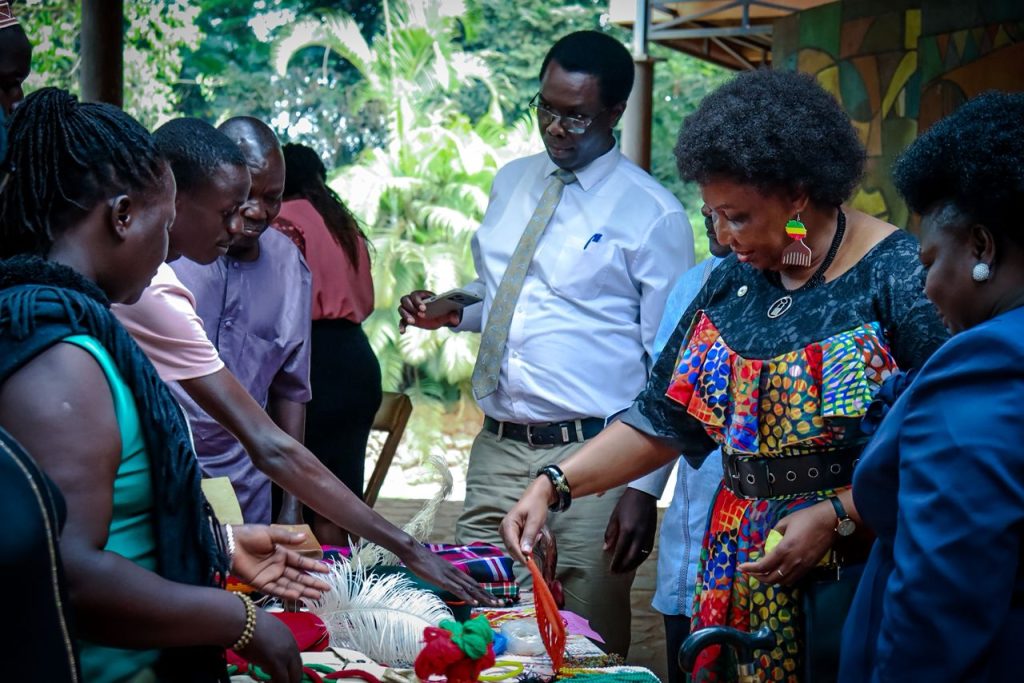
The Cross-Cultural Foundation of Uganda (CCFU), in partnership with the Equal Opportunities Commission (EOC), marked the 2025 International Day of the World’s Indigenous Peoples on 8 August at Ndere Cultural Centre in Kampala. The event brought together Indigenous Minority Groups (IMGs), government officials and civil society actors to reflect on the urgent need to uphold the rights of Uganda’s indigenous communities. The day included cultural exhibitions, dialogues, and networking sessions designed to amplify indigenous voices in policy-making, cultural preservation, and development planning.
Stories of Empowerment
For members of the Mosopisyek community in Elgon, the support from CCFU has transformed livelihoods and cultural pride. Eunice Chesang, part of a women’s group, explained how a small grant and training in enterprise management turned their craft-making into a sustainable income source:
“Before the support, we only made crafts for home use. Now, we produce high-quality cultural crafts and sell them at local markets and exhibitions. Our income has tripled. I was able to take my children back to school. Our culture is our strength and our business,” she said.
Similarly, Emmanuel Kyalimpa, Chairperson of the Rwenzori IMG Platform, reflected on how advocacy and visibility have strengthened indigenous communities: “For years, we felt invisible. But with CCFU and EOC’s support, our culture is now being recognised and respected. Through our platform, we have engaged district leaders, shared our history and advocated for the protection of our sacred sites. We are no longer silent, we are organised and hopeful.” These stories of empowerment illustrate how targeted support can transform lives, enabling communities to reclaim cultural practices while improving economic security.
Voices of Advocacy
Speakers at the event emphasised the urgent need to tackle marginalisation. Ms. Barbra Babweetera, Executive Director of CCFU, highlighted the challenges Indigenous Minority Groups face, “In many parts of Uganda, Indigenous Minority Groups face marginalisation that threatens their way of life, their identity, and their ability to thrive. This year’s theme speaks directly to the urgent need to uphold their right to self-determination, not only as a matter of human rights, but as a foundation for achieving food sovereignty, sustainable development and national cohesion.”
Ms. Safia Nalule Juuko, Chairperson of the Equal Opportunities Commission, reaffirmed the Commission’s commitment, “As a Commission, we recognise that Indigenous Minority Groups continue to be left behind in development planning and service delivery. We are working to ensure that their voices are heard and that their rights to land, education, and cultural expression are protected. Today’s dialogue is an important step toward justice and equity for these communities.”
The discussions stressed that Indigenous voices are essential for creating policies that safeguard cultural heritage, promote food security, and ensure sustainable development.
Indigenous Voices on Urgent Challenges
For many Indigenous Minority Groups, cultural survival is under threat. Sacred rivers, caves, burial grounds and salt licks, places that hold stories of ancestors and spiritual meaning are increasingly out of reach. Communities such as the Batwa and Mosopisyek are often barred from their ancestral lands, leaving traditions on the brink of extinction.
Language loss adds another layer of urgency. Children in Kiryandongo,Busongora and Kween are now taught in dominant regional languages rather than their own, eroding centuries of knowledge and identity. Leaders are calling on the Ministry of Education and Sports to support indigenous languages in schools, develop learning materials, and preserve these living traditions.
Political underrepresentation and lack of recognition in official records further deepen marginalisation. Groups like the Mosopisyek, Bakingwe, Bagabo, and Maragoli remain absent from Uganda’s 1995 Constitution, restricting access to essential rights and services. Community leaders insist on constitutional reforms, respectful recognition and reserved representation in governance to ensure their voices guide decisions affecting their lives.
The communities’ message is clear about protecting cultural heritage, safeguarding access to ancestral lands and amplifying indigenous voices are not optional but vital. As one leader put it, “Our history, our land, our language and our rituals are not relics of the past but the foundation of who we are, how we feed our families and how we shape our future.”
The event also served as a platform to raise actionable recommendations. Indigenous communities urged government agencies to grant regulated access to protected areas, integrate indigenous languages into the education system, support cultural documentation and promotion and establish a national platform to connect with regional and international Indigenous forums.
Through its work with over 20 IMGs, Cross Cultural Foundation Uganda continues to advocate for cultural rights, document oral histories, support cultural resource centres and museums, and provide livelihood support through grants, skills training and education. Communities such as the Mosopisyek, Batuku, Banyabindi, Basongora, and Batwa are reclaiming their heritage and improving socioeconomic conditions with these interventions.
The day ended with renewed commitment from all stakeholders to ensure that Indigenous Minority Groups are heard, respected and included in the development narrative of Uganda. For Uganda’s indigenous communities, the message was clear that recognition, respect, and empowerment are no longer optional but essential for survival and a thriving future.